Chromatography
Ion Chromatography Mass Spectrometry (IC-MS) is a powerful tool to handle many challenging analytical tasks.
Ion chromatography tackles difficult separation problems of various ionic species and typically works with conductivity detection. Mass detection as a secondary independent detector, confirms the identity of analytes in difficult matrices to ensure correct results. Even co-eluting components can be quantified and detection limits are considerably improved. Various ions, such as nitrate, phosphate, perchlorate, thiosulfate or thiocyanate are reliably separated and detected. Difficult matrices like soil or explosion residues can be removed with automated sample preparation techniques (e.g. with Inline Ultrafiltration or Dialysis).
The technique is a robust and easy-to-use way to monitor anions and oxoanions in various matrices, e.g. in environmental, post-explosion and semiconductor samples.
This technique is dedicated to develop selective, sensitive, robust and as fast as possible applications for the detection of ions in matrix-loaded samples.
Only small sample volumes in the μL-range are necessary. Automatic sample preparation (e.g. Inline Ultrafiltration, Dilution or Dialysis) guarantees reproducible results and minimum time for lab work.
Organic modifiers can be directly added to the eluent (up to 100%) to improve sample evaporation and MS-signals. Since the suppressor is solvent compatible, solvent addition after suppression is not necessary (which would further dilute the sample and which would make the setup less sensitive and less robust).
In order to detect small ions such as chloride (m/z 35) the MS must be sensitive for low m/z values, which was possible with optimised settings on the SQ Detector 2.
A diverter valve between IC and MS was used to only switch the flow to the MS when analytes of interest are expected. The conductivity signal is also a good tool to monitor the status of the system.
During instrument equilibration, automated sample preparation or the elution of matrix components, the flow is switched to the waste in order to avoid contamination of the MS detector. Metrohm IC and Waters MS are easily operated under just one software (Empower 3).
Information on retention time, molecular mass, isotope patterns and fragmentation are useful when screening for unknown ions. The two independent detection techniques (conductivity and mass detection) enable to identify and confirm eluting substances with certainty.
• Any eluent can be used because the suppressor is resistant to organic solvents (up to 100%) and pressure stable
• Short conditioning time
• Minimum noise of < 0.2 nS/cm
• Cost-effective and robust
• Application can be changed at any time with no negative impact on system performance
• Excellent signal-to-noise ratio enables anions and organic acids to be analysed down to the ultratrace range
• 10 year warranty (anion suppressor)
All three suppressor rotors – MSM-HC, MSM, and MSM-LC – have the same design and vary solely in terms of their capacity.
Settings of the mass spectrometer were optimised for small m/z. By an adapted tuning, low concentration levels of ions can be detected.
Eluent: Na2CO3/Na2HCO3 3.2/1.0 mmol/L, 10% acetonitrile; flow rate 0.6 mL/min; injection volume 20 µL; 30°C; sequential suppression; detection: SIR (ES-)
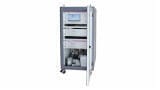
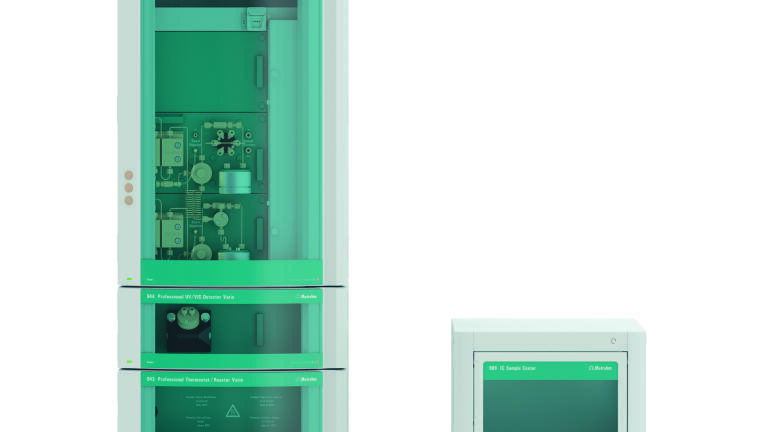
940 Professional IC Vario Robust ion chromatograph
889 IC Sample Center – cool For cooling and small sample volumes
IC Conductivity Detector Monitoring of conductivity
Metrosep A Supp 7 Separation of anions and oxoanions
MSM Rotor A Suppression
Remote Box MSB Synchronisation of IC and MS
Metrohm IC Driver for Empower Control of IC
Empower 3 One-software solution
Waters SQ Detector 2 Mass range 2 - 2 048 m/z
Samples with a high load of matrix components can damage the separation column or lead to blockages in the system. That is why suitable sample preparation is essential for reliable and accurate analysis.
In the past, all sample preparation steps had to be carried out manually. With the unique Metrohm Inline Sample Preparation (MISP) techniques, it is now possible to fully automate these processes and make each individual step traceable. The high precision and accuracy of these techniques are excellent and are accompanied by significant time and cost savings as well as an outstanding reliability of your analyses.
• Inline Ultrafiltration
• Dialysis
• Dilution
• Preconcentration and matrix elimination
• Extraction
• Neutralisation
Filtration is generally recommended in IC to avoid blockages in the injection valve, in the capillary connection, and in the column. It is indispensable for samples containing particles. Inline Ultrafiltration combines sample injection directly with filtration. The two parts of the ultrafiltration cell are separated by a filter membrane. On one side, the sample is carried through the cell at a high flow rate. On the other side, some of the sample is drawn off through the membrane and transported to the injection valve. The formation of filter cake is prevented by continuous flushing of particles out of the cell at a high flow rate.
Anions and Oxoanions including thiosulfate, thiocyanate, and perchlorate were separated on a Metrosep A Supp 7 - 150/2.0 within 15 minutes.
Conditions: 1 mg/L standard; eluent A: 3.6 mmol/L Na2CO3, eluent B: 20.0 mmol/L Na2CO3; flow rate: 0.6 mL/min; injection volume 10 µL; 55°C; sequential suppression; detection: conductivity
Perchlorate is a serious threat to human health. It was determined in various matrices according to norm US EPA 332.0
Eluent: 30 mmol/L NaOH + 30% MeOH (v/v); flow rate: 0.8 mL/min; injection volume: 350 µL; 30°C; chemical suppression; detection: SIR (ES-)
Most analytes can be detected with conductivity. However, co-elution can hamper the quantification when concentration differences between matrix and analyte become too big.
With a mass detector in series, quantification is possible. Positive peak identification is assured by correlating the conductivity signal with the respective SIR signal (m/z of the analyte).
Conditions: 5 mg/L chloride, nitrate, sulphate, 0.1 mg/L bromide, 5 µg/L chlorite, chlorate, bromate, TFA; eluent: 3.6 mmol/L Na2CO3 + 10% acetonitrile; flow rate 0.6 mL/min, injection volume 10 µL; 45°C; sequential suppression; detection: conductivity & SIR (ES-)
The International Agency for Research on Cancer (IARC) stated that the herbicide glyphosate (N-(phosphonomethyl) glycine) was «probably carcinogenic to humans». Glyphosate and its metabolite AMPA (aminomethylphosphonic acid), as well as other common pesticides were determined by ion chromatography coupled with a mass-selective detector.
Eluent: (NH4)2CO3/NH4OH; 70/100 mmol/L, 30% isopro panol; flow rate: 0.3 mL/min; 32°C; injection volume 200 µL; 32°C; detection: SIR (ES-)
PIN 27.2 Apr/May 2026


 Product directory